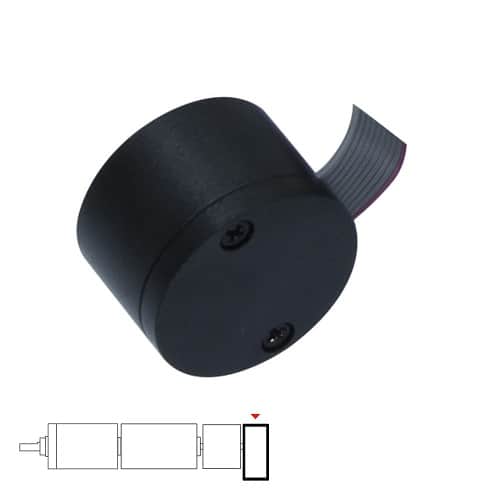
Optical vs Electromagnetic
Once you have chosen between incremental and absolute, the next decision is the sensing technology. Assun's encoders use either optical or electromagnetic (magnetic) sensing, each with distinct strengths.
Optical Encoders (T suffix in model code)
Optical encoders use a light source, a patterned disc, and photodetectors to generate position pulses. The optical sensing mechanism offers high resolution Assun's optical encoders are available up to 4096 pulses per revolution and very precise edge detection, which is why optical encoders are the preferred technology for precision motion control: laboratory instruments, medical equipment, semiconductor positioning stages, and precision robotics.
Electromagnetic Encoders (S suffix in model code)
Electromagnetic (magnetic) encoders use a magnetic field and a sensor rather than light and a disc. This makes them more resistant to contamination dust, oil mist, and moisture that would interfere with an optical sensing path have minimal effect on a magnetic sensor. They are also generally more robust under vibration and mechanical shock. Assun's electromagnetic encoders are well-suited to industrial environments where cleanliness cannot be guaranteed.
For most precision laboratory and medical applications, optical is the right choice. For factory environments, downhole equipment, or applications with significant vibration, electromagnetic is the more reliable option.
How Assun's Encoders Pair With the DC Motor Range?
Assun's motor encoders are engineered to mount directly to Assun's brushless coreless DC motor (BLDC) range and brushed coreless DC motor range. The encoder diameter and mounting interface are matched to the motor shaft and end-plate geometry, eliminating the fit verification work required when sourcing an encoder separately.
For complete servo drive systems, Assun's servo motor controller accepts the encoder's output directly with both incremental channel and absolute serial interface supported depending on the controller variant selected.
For motor-gearbox assemblies where the encoder must mount to the motor shaft upstream of the planetary gearbox, Assun can supply the complete matched stack motor, encoder, and gearbox with verified interface compatibility. For DC integrated servo motors, the position feedback is already built in and a separate encoder is not required. All encoder-motor compatibility questions can be directed to Assun's US engineering team.
Where Motor Encoders Are Specified in the US Market?
Assun's motor encoders are specified across several demanding market segments:
- Collaborative Robots and Servo Axes: Each joint axis in a robot arm needs a motor encoder for closed-loop position and velocity control. The 16mm and 22mm incremental optical encoders (AM-EN1612T, AM-EN2412T) provide the high resolution needed for joint servo loops. For systems that must know joint position immediately on startup without a homing sequence, the absolute electromagnetic encoders (AM-EN1611S113, AM-EN2211S113) eliminate the homing step entirely.
- Medical Devices and Surgical Instruments: Optical encoders provide the resolution and precision required for infusion pump speed control, surgical robot joint feedback, and diagnostic instrument positioning. The compact 10mm×8mm AM-EN1008 electromagnetic encoder serves miniature motor applications in handheld surgical tools.
- Semiconductor Equipment: Optical encoders are standard in wafer handling stages and inspection systems where position repeatability must be maintained at the micron level over millions of cycles.
- Industrial Automation: Electromagnetic encoders serve factory automation applications where oil mist, dust, and vibration make optical sensing impractical.
FAQs
Q1. What is a motor encoder?
A motor encoder is a feedback device that converts mechanical shaft rotation into electrical signals, reporting position, speed, and direction to the motor's controller. It makes closed-loop servo control possible allowing the controller to detect and correct errors in real time rather than simply issuing commands and assuming the motor follows them. Motor encoders are attached directly to the motor shaft and are a standard component in servo motors, collaborative robots, CNC machines, and precision positioning systems.
Q2. What is the difference between an incremental and absolute encoder?
An incremental encoder generates pulses as the shaft rotates, counting position relative to a starting reference. On power-up, it requires a homing sequence to find that reference. An absolute encoder outputs a unique position code for every shaft angle and knows its position immediately on startup no homing required. Choose incremental for high-cycle servo drives and CNC systems where homing is practical. Choose absolute for applications where position must be known after a power loss, or where a homing sequence is mechanically impossible or unsafe.
Q3. What is the difference between an optical and electromagnetic (magnetic) encoder?
Optical encoders use a light source, patterned disc, and photodetectors to generate position signals offering high resolution and precise edge detection, making them preferred for clean precision applications. Electromagnetic (magnetic) encoders use a magnetic field and sensor, making them resistant to contamination from dust, oil, and moisture, and more robust under mechanical shock and vibration. For laboratory and medical applications, optical is typically the right choice. For harsh industrial environments, electromagnetic offers better long-term reliability.
Q4. What resolution do Assun's motor encoders offer?
Assun's optical incremental encoders are available in configurations up to 4096 pulses per revolution (PPR). Higher PPR means finer angular resolution per pulse 4096 PPR on a 360° shaft yields approximately 0.088° per pulse, or about 5.3 arcminutes. Assun's absolute electromagnetic encoders provide 40 revolve bits and 96 angular bits of resolution. For specific resolution options per model series, consult the product datasheet or contact Assun's US engineering team.
Q5. What sizes are Assun's motor encoders available in?
Assun's motor encoder range covers 10mm to 45mm outer diameter. The 10mm×8mm series (AM-EN1008) is the most compact designed for miniature coreless motor applications where total assembly length and diameter are critical constraints. The 16mm, 22mm, 24mm, and 36mm sizes serve progressively larger motor platforms. All standard sizes are available for direct purchase through the Assun online shop.
Q6. Can Assun's encoders be used with motors other than Assun's?
Assun's encoders are designed with mounting interfaces matched to Assun's coreless DC motor range. Third-party compatibility depends on the motor's shaft diameter and end-plate geometry refer to the encoder's mounting dimension specifications in the datasheet. For third-party motor integration, contact Assun's US engineering team with the motor shaft and end-plate dimensions for a compatibility assessment.
Q7. What is the difference between a two-channel and three-channel encoder?
A two-channel incremental encoder (002 designation in Assun's model code) provides A and B quadrature signals these identify shaft position increment and direction of rotation. A three-channel encoder (003 or 103 designation) adds the Z index channel, which generates one pulse per full revolution at a fixed angular position. Use a two-channel encoder for basic speed and direction feedback where homing to an external reference (limit switch or hard stop) is acceptable. Use a three-channel encoder when the servo system needs the motor shaft's own index pulse for position referencing.

 Online Shop