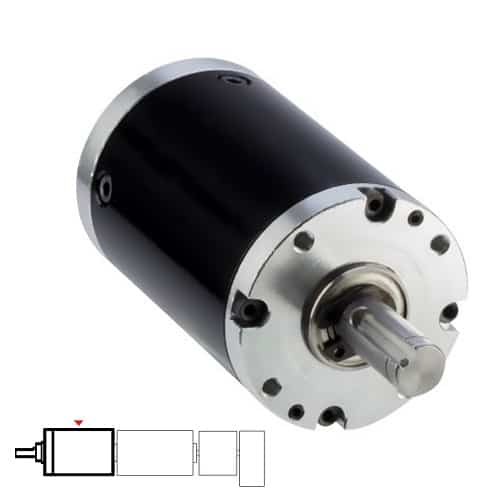
How a Planetary Gearbox Works?
The classic spur gearbox transmits torque through one gear mesh at a time. A planetary gearbox does it differently: the sun gear at the centre drives three or more planet gears simultaneously, and those planet gears all mesh with the outer ring gear. This parallel torque path is the key to the planetary design's main advantages.
First, distributing the load across multiple gear meshes reduces stress on individual gear teeth, which increases torque capacity without requiring a larger housing. Second, the coaxial geometry input and output shaft sharing the same centreline makes integration into a motor-gearbox assembly straightforward; there is no offset output shaft to accommodate. Third, because the gear engagement is continuous and symmetric, the gearbox runs quietly and produces relatively low vibration compared to single-mesh alternatives.
Multi-stage planetary gearboxes stack these assemblies in series Assun's range supports up to 5 stages in the same diameter. Each additional stage multiplies the reduction ratio by the single-stage ratio, allowing very high overall reductions while keeping the assembly length modest.
How to Select a Planetary Gearbox?
Planetary gearbox selection follows a logical sequence. Work through these parameters in order and the model code will identify your options directly.
- Output torque requirement: This is the most important parameter. Calculate your peak load torque at the gearbox output shaft, including acceleration torque if your application involves rapid start-stop cycles. Confirm the selected gearbox's rated output torque exceeds this value with appropriate safety margin.
- Gear ratio: The ratio you need is driven by your motor's operating speed and your required output speed. A 4-pole pair brushless motor running at 10,000 RPM with a required output of 500 RPM needs a 20:1 overall reduction achievable in 2 stages with appropriate single-stage ratios.
- Diameter: The gearbox outer diameter must fit within your mechanical envelope. Assun's range starts at 8mm useful for tightly constrained robotic joints or instrument drives and extends to 52mm for higher-torque applications. Remember that a larger diameter gearbox can produce the same output torque with fewer stages.
- Backlash tolerance: Choose the series (P, GP, or HP) based on your positioning accuracy requirement. If your application uses encoder feedback and corrects position in a closed loop, modest backlash is tolerable. If the mechanical output position must be accurate at the tool tip without closed-loop correction, choose the tightest backlash series available.
- Stage count: Use the number of stages (A through E in the model code) to achieve your required overall ratio within your space constraint.
Applications of Assun's Planetary Gearboxes
Assun's planetary gearbox range is compact enough for the precision motion applications that define the US market for small gearboxes:
- Robotics and Collaborative Robot Arms: Planetary gearboxes are the dominant gearbox type for robot joints their coaxial geometry, high torque density, and low backlash make them the natural choice for joint actuators where compactness and positioning accuracy are both required. Assun's GP and HP series are specified in robot wrist joints, elbow joints, and linear axis drives.
- Semiconductor Equipment and Precision Automation: Wafer handling systems, inspection stages, and optical alignment equipment need gearboxes that maintain positional accuracy over millions of cycles without increasing backlash over time. The HP series' tight tolerance manufacturing is appropriate for these applications.
- Medical Devices and Lab Instruments: Surgical robot joints, robotic laboratory workstations, and motorised positioning stages in diagnostic equipment all benefit from the compact size and quiet operation of Assun's planetary gearbox range.
- Industrial Automation: The Regular (P) series serves general automation, conveyor drives, and valve actuators where cost-effectiveness is the primary driver and precision is secondary.
Pairing a Planetary Gearbox with an Assun Motor
One of the most time-consuming steps in drive system design is validating mechanical compatibility between a motor and a separately sourced gearbox shaft diameter tolerances, input flange geometry, and coupling concentricity all need to be confirmed before a system can be assembled and tested.
Assun's planetary gearboxes are designed to mount directly to Assun's brushed coreless DC motors and brushless coreless DC motors (BLDC), with the input interface geometry encoded in the model code. Specifying a motor-gearbox combination from Assun's range eliminates this interface validation step. The assembly arrives characterised and ready to integrate.
For applications requiring position feedback, Assun also supplies motor encoders in incremental and absolute variants that mount directly to the motor shaft upstream of the gearbox. For complete closed-loop drive systems, the servo motor controller rounds out the drive chain.
FAQs
Q1. What is a planetary gearbox?
A planetary gearbox is a type of gear reducer that uses a central sun gear, multiple surrounding planet gears, and an outer ring gear to transmit torque. The load is shared across multiple gear meshes simultaneously, which gives planetary gearboxes high torque density, compact size, and coaxial input-output geometry. They are widely used in robotics, automation, medical devices, and semiconductor equipment for speed reduction and torque multiplication.
Q2. How does a planetary gearbox differ from a spur gearbox?
A spur gearbox transmits torque through a single gear mesh at a time, with offset input and output shafts. A planetary gearbox distributes load across three or more gear meshes simultaneously, shares the same centreline for input and output shafts, and achieves higher torque capacity in a smaller radial footprint. Planetary gearboxes are also generally quieter under load due to the continuous symmetric gear engagement. Spur gearboxes are simpler and lower cost for the same gear ratio, but they cannot match the torque density of a planetary design in a compact form.
Q3. What is backlash in a gearbox and why does it matter?
Backlash is the angular movement of the output shaft that occurs when the drive direction is reversed without corresponding movement of the input shaft essentially the mechanical play between gear teeth. In positioning applications, backlash translates directly into positioning error at the output: if the gearbox has 5 arcminutes of backlash, the output shaft can move 5 arcminutes in either direction before the input gear engages. For collaborative robots, CNC machinery, and servo-controlled axes, minimising backlash is essential for positioning accuracy and control loop stability.
Q4. What is the difference between Regular, Precision, and High Performance planetary gearboxes?
Assun's planetary gearboxes are available in three series. The Regular (P) series is built to standard tolerances and is cost-effective for general automation and non-precision drives. The Precision (GP) series applies tighter manufacturing tolerances for reduced backlash, making it suitable for robotics, semiconductor equipment, and servo motor drives requiring repeatable positioning. The High Performance (HP) series uses the tightest tolerances available in the Assun range, with minimum backlash and maximum torsional stiffness appropriate for high-cycle robot joints, precision medical instruments, and applications where backlash directly affects tool-tip accuracy.
Q5. How many stages does a planetary gearbox need?
The number of stages determines the overall gear ratio. A single-stage planetary gearbox typically achieves ratios from 3:1 to 9:1 depending on the design. Each additional stage multiplies the ratio further: a 2-stage unit achieving 5:1 per stage produces 25:1 overall. Assun's range supports up to 5 stages in the same diameter, allowing very high overall reduction ratios. The number of stages also affects total gearbox length more stages add axial length. Choose the minimum number of stages that achieves your required ratio within your mechanical envelope.
Q6. What diameter planetary gearboxes does Assun offer?
Assun's planetary gearbox range covers outer diameters from 8mm (AM-10GP series, the smallest in the GP range) to 52mm (AM-52GP series). Within each diameter, multiple stage configurations are available. The GP series has the broadest diameter coverage. The P series covers 16mm to 45mm. The HP series covers 12mm to 26mm. All standard configurations are available for direct purchase through the Assun online shop.
Q7. Can Assun's planetary gearboxes be used with third-party motors?
Assun's planetary gearboxes are designed with input interfaces matched to Assun's motor range. Third-party motor compatibility depends on shaft diameter, flange geometry, and interface dimensions these are specified in the individual series datasheets. For applications where you need to interface an Assun gearbox with a third-party motor, contact Assun's US engineering team with the motor's shaft specification and they can advise on compatibility or custom adapter options.
Q8. What is a planetary gear motor?
A planetary gear motor is a combined unit consisting of an electric motor and a planetary gearbox assembled as a single integrated component. The gearbox mounts directly to the motor output shaft, reducing speed and multiplying torque. Assun supplies both motors and planetary gearboxes separately, and the two product ranges are designed with compatible interfaces so engineers can build their own matched motor-gearbox assembly. Combined motor-gearbox units simplify installation and reduce mechanical interface uncertainty compared to specifying the two components from different suppliers.

 Online Shop