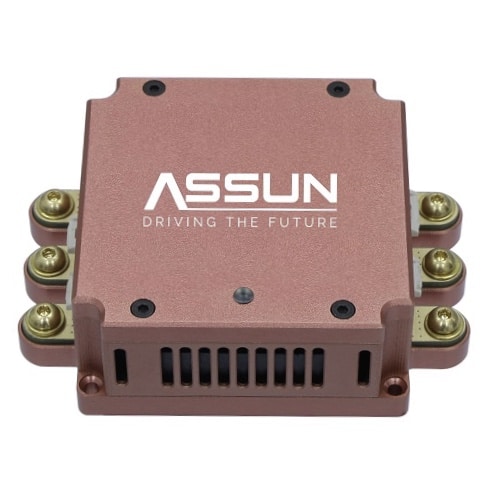
Where Are Assun Servo Controllers Used?
The four Assun servo controller variants cover a wide range of motion control applications in the US market:
- Collaborative robots and multi-axis systems: EtherCAT and CAN Bus models provide precise synchronisation for robotic joints and other multi-axis systems.
- Medical devices: Traditional control models are ideal for surgical equipment, diagnostic devices, and other standalone precision positioning applications.
- Semiconductor equipment: EtherCAT controllers are widely used in wafer handling and inspection systems where high speed and positioning accuracy are essential.
- Industrial automation and packaging: Traditional control models with RS-485 support are well suited for packaging machines, dispensing systems, and conveyor applications with fixed motion profiles.
How to Choose the Right Servo Motor Controller?
Choosing the right servo motor controller comes down to three key factors:
- Communication protocol: Select the controller that matches your automation system—Traditional Control for step/dir signals, CAN Bus for CANopen networks, or EtherCAT for EtherCAT-based systems. Traditional models are also available with RS-485 communication.
- Voltage and current: Match the controller to your DC bus voltage and ensure the current rating meets your application's operating requirements.
- Operating temperature: Standard A Grade controllers support -40°C to 85°C. B and C Grade models are available for higher-temperature environments.
If your application falls outside these parameters or requires a custom configuration, contact our US engineering team.
Three Control Modes: Position, Speed and Torque
All four Assun servo controller variants support the same three control modes. The mode is selected during configuration and can in some applications be switched dynamically.
- Position Control: The controller targets a specified shaft angle and holds it against load disturbances. Incoming commands specify a target position via pulse count, analogue voltage, or fieldbus setpoint depending on the variant. Position control is the mode used in robotic joints, linear stages, and any axis that needs to move to and hold a defined location.
- Speed Control: The controller maintains a commanded rotational speed regardless of load variation. The target speed is specified via analogue voltage (0–5V or 0–10V) or fieldbus. This mode is appropriate for conveyor drives, pump applications, and any continuous motion axis where consistent velocity matters more than absolute angular position.
- Torque Control: The controller regulates the motor's output torque rather than its position or speed. Torque control is used in tension control applications, press force control, and haptic feedback systems where the force the motor produces not its position is the primary variable.
Feedback inputs supported across all variants include incremental encoders (differential and single-ended), SSI absolute encoders, RS-485 absolute encoders, and hall sensors.
Pairing With Assun's Motor Range
Assun's servo motor controllers are designed to work with Assun's brushless coreless DC motors (BLDC) and brushed coreless DC motors, with the model code's feedback type parameter encoding the motor's sensor configuration directly.
For engineers who want a fully integrated solution without a separate external controller, Assun's DC Integrated Servo Motor incorporates the position servo controller inside the motor housing eliminating the external controller and encoder wiring entirely. That product is the right choice when space is the primary constraint and the application is single-axis with a simple command interface.
For multi-axis systems, mixed-protocol networks, or any application requiring a configurable standalone controller with fieldbus integration, the external servo motor controller on this page is the appropriate selection. Both products are available through the Assun online shop.
FAQs
Q1. What is a servo motor controller?
A servo motor controller also called a servo drive is an electronic unit that manages the position, speed, or torque of a servo motor using closed-loop feedback. It continuously reads a position or speed signal from a motor-mounted encoder or hall sensor, compares it to the commanded value, and adjusts the drive current to eliminate any error. Unlike a simple motor driver that regulates voltage, a servo controller makes the motor aware of its own state and able to self-correct in real time.
Q2. What is the difference between a servo controller and a servo drive?
In practice, servo controller and servo drive are used interchangeably in the industry. Some manufacturers use 'servo drive' to refer to the power stage only (the unit that converts DC bus power into motor phase current), while 'servo controller' implies the combined unit including position/speed/torque feedback algorithms. Assun's products are self-contained units handling both drive power and closed-loop control logic either term applies.
Q3. What communication protocols do Assun's servo motor controllers support?
Assun offers four servo controller variants: Traditional Control (direction + pulse, analogue input, USB commissioning), CAN Bus Control (RS422, RS485, CAN Open, USB commissioning), EtherCAT Communication (EtherCAT slave with USB commissioning), and a Traditional Control + RS-485 variant. The choice depends on the communication protocol of your existing motion controller or automation platform.
Q4. What is EtherCAT and why is it used in servo controllers?
EtherCAT (Ethernet for Control Automation Technology) is a real-time fieldbus protocol that uses standard Ethernet hardware to achieve sub-millisecond cycle times and microsecond-level synchronisation across multiple slave devices. In multi-axis servo systems particularly collaborative robots and semiconductor equipment EtherCAT allows all servo axes to receive synchronised position commands from a central motion controller at very high update rates. It is the dominant fieldbus in precision multi-axis automation and is supported by industrial PCs from Beckhoff, Omron, and similar platforms.
Q5. What control modes do Assun's servo controllers support?
All Assun servo motor controller variants support three control modes: position control (the motor targets and holds a specified shaft angle), speed control (the motor maintains a commanded rotational speed), and torque control (the motor regulates its output torque to a commanded level). The active mode is selected during commissioning via the PC configuration interface.
Q6. What feedback types are supported?
Assun's servo motor controllers accept the following feedback inputs: incremental encoders with differential output, incremental encoders with single-ended output, SSI absolute encoders, RS-485 absolute encoders, and hall sensors. This range covers the majority of motor feedback configurations used in precision DC motor applications.
Q7. What motors are compatible with Assun's servo motor controllers?
Assun's servo motor controllers are designed to work with Assun's brushless coreless DC motors (BLDC) and brushed coreless DC motors. The model code's feedback type parameter is configured to match the motor's sensor type during setup. For engineers who want a fully integrated motor-plus-controller solution without a separate external controller, Assun's DC Integrated Servo Motor is an alternative product that incorporates the servo controller inside the motor housing.

 Online Shop