

Encoders are some of the most important pieces of equipment for servo, heavy-duty, and DC motor applications. Absolute encoders provide feedback to help companies with their production and quality control. Our absolute encoders provide accurate feedback, so you can continue to receive the most relevant and updated information on the position of products on assembly lines, robotics applications, and much more.
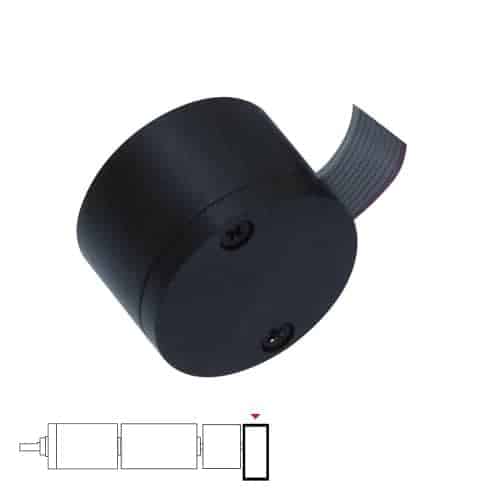
What is an Absolute Encoder and How Does it Work?
What is an Absolute Encoder?
An absolute encoder is a type of device used to give feedback on the speed, position, angular position, and direction of an object. Unlike incremental encoders, the term “absolute encoders” is due to the fact that they provide an ” absolute” position. Absolute encoders generate information about the relative position and absolute position of an object, including after a power outage.

Cross Section of Assunmotor Absolute (Electromagnetic type) Encoder
Working Principle of an Absolute Encoder
An absolute encoder might seem difficult to understand, but knowing its components and how they work together can make it a bit clearer. An absolute rotary encoder works by using a rotating disc with slits cut inside of them, which resemble the spokes on a bicycle tire. This rotating disc is placed in front of a light source and light transducer, such as in the case of an optical rotary encoder, or it can be outfitted with a magnetic sensor that detects changes in magnetic energy, such as in an electromagnetic encoder.
Both types of absolute rotary encoders produce an output signal which can be translated digitally into specific information about an object’s movement and absolute position. To do so, the following occurs:
- The rotating disc, also known as an optical disc, spins around a hollow shaft, allowing light to enter only in areas that have open slits. The rest of the disc is opaque, blocking out light and signals.
- The light enters the disc and passes through the slits of the disc. This light is fixed and is not disturbed by outside light sources. Many encoders use infrared lights for feedback.
- There is a specific pattern cut into the rotary disc of absolute encoders. Based on the signals per revolution, the light being transmitted, or a magnetic signal being interpreted, the transducer in the absolute rotary encoder produces a digital signal.
- The digital signal is delivered to another system that interprets the exact position of an object based on the signals received.
At Assun Motors, we carry a line of absolute rotary encoders that reveal exact position of an object, even after there is a power outage. Our encoders produce a digital signal through optical and electromagnetic fields. We have rotary encoders, which are the most popular types of encoders on the market and the easiest to place into your existing configuration.
Absolute Encoder Output

Assunmotor’s Absolute Encoder Output
Reading the output signal of an absolute encoder is a bit more complex than reading the output signal of an incremental encoder. Unlike an absolute encoder, an incremental encoder sits on a rotating shaft and has a disc with a uniform pattern of slits. You can imagine these slits look like a pie, cut uniformly throughout the disc.
Incremental encoders work much the same as absolute encoders, but they only produce limited information. An incremental encoder produces an output signal that reveals information about the relative position of an object, but not its true position. It does so by using a known fixed position for reference.
Using information from the fixed position, incremental encoders can provide information on the relative distance of an object and information such as counts. It produces a signal that appears as a “A” or “B” square wave, or a cosine wave.
However, an absolute encoder provides a digital data stream, such as a serial synchronous interface or SSI. This is a digital signal that reads between 0 to 10 volts or 4 to 20 mA. These signals give highly accurate position information through a unique code.
Advantages of Using Absolute Encoders
There are several advantages to using absolute encoders. For starters, absolute encoders provide accurate information and the unique position data of an object. This means that you can know exactly where a product or part is on your assembly line at all times. This is much different than an incremental encoder, which is best reserved for smaller applications that don’t require positional feedback but do require information such as counts and distance.
If your company requires position feedback due to functional safety reasons, absolute encoders are also a good choice. In addition, an absolute encoder saves you time on programming. While incremental encoders need to start from “0” and thus need to constantly be programmed with the relative position of a reference object, absolute encoders can pick up where they left off.
Absolute encoders even provide information when there is a power outage. Absolute encoders can, therefore, minimize damage to an assembly line production and increase productivity flow. Though there is a significant price gap between incremental and absolute encoders, absolute encoders are well worth the cost and can save you money if you need to halt and start production again.
Absolute Encoder Specifications
It’s important to find the right specifications for your absolute encoder. Below are some common configurations for an absolute rotary encoder. Assun Motors has other specifications and products available, so you can find the right type of encoder for your industry.
| Diameter | φ 16 mm | Length | 10.7 mm |
| Type | Absolute | Principle | Electromagnetic Encoder |
| Resolution | 16 ppr | Max. Channels | 3 |
| Max. Working Frequency | 10,000 kHz | Differential Signal | Yes |
| Power Vcc | 5 V | Signal Protocol | SSI |
| Operating Temperature | -40~125 ℃ | Inertia (Max.) | 0.015 g.cm² |
| Max. Output Current/Channel | 20 mA | Weight | 6.5 g |
What are the Parts of the Absolute Encoder?
A rotary absolute encoder contains several parts that allow it to function for a variety of applications. The parts of an encoder include a fixed light source and light detector, rotating shaft, a rotary coded disc, and an output signal processor. These parts are not limited by size, meaning you can use absolute encoders in applications you need to maximize the space available.
Where are Absolute Encoders used?
You can use rotary absolute encoders in a variety of different applications. Both optical and electromagnetic encoders can be used in fields such as:
- Surgical robotics to give accurate information on the position of a robotic arm
- Diagnostic imaging, providing feedback for MRI machines, X-Rays, and CT scans
- Radiation therapy, which provides extremely accurate feedback for machines aiming lasers at cancerous tumors, and can help reduce the amount of time a patient is involved in radiation therapy
- Satellite communications, to strengthen transmission signals and provide absolute position from anywhere in the world
- AUVs and ROVs, which need accurate information that is continuously updated in order to explore the depths of the ocean floor
- Industrial robotics applications and automated assembly lines
- Photonics applications that use light beams
- Microelectronics and the manufacturing of PCBs and super computers
- Scientific applications such as research studies
Conclusion
Absolute encoders will provide meaningful positioning information of an object in real time. They can be configured to serve in a variety of applications, and can be used during product design and manufacturing, robotics, medical applications, and much more.
Assun Motors offers a complete line of absolute and incremental encoders, so you can find the right type of encoder for your business.
Read our blog posts today so you can find the best incremental, absolute, electromagnetic, or optical encoder for your industry today.
You Might be Interested in Reading These;
Latest Posts
 by AssunMotor
Servo Motor Controller: How It Works, Applications & Benefits
In the realm of industrial automation and precision engineering, the ability to control motor movements with high accuracy is crucial. A servo motor...
 by Mir A. Hossain
What is a DC Motor and Its Working Principle?
A Direct Current motor, a DC motor, is an electrical instrument that is operated by direct current and transforms electrical energy into mechanical energy....
by AssunMotorUnderstanding DC Brushless Motor Efficiency & How to Test For It
Brushless DC motors are some of the most efficient and long-lasting motors available on the market today. But what exactly makes them so efficient compared...