

For industry and engineering professionals that need a solution for accurate feedback, incremental encoders provide valuable data to provide the most accurate information based on real-time measurements. Heavy-duty, light, or servo applications all make use of incremental encoders. These incremental encoders can provide input on distance using linear or rotary output signals.
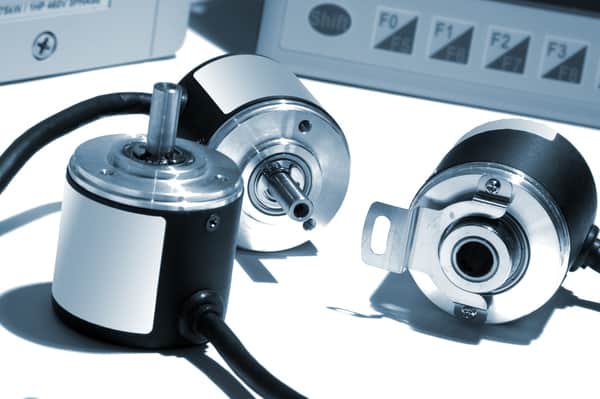
What is an Incremental Encoder & How Does it Work?
What is Incremental Encoder?
Incremental encoders use mechanical system information, such as reference position and changes in movement, to provide electrical output signals that are digitally translated. An incremental encoder can provide information on an object’s distance, speed, and linear position. However, it cannot provide information on the absolute position of an object.
Incremental Encoder Working Principle
An incremental encoder is a type of encoder that provides feedback on distance, speed, and rotational angle. However, unlike an absolute encoder, it cannot provide information on the specific location of an object, also known as its absolute location. It’s important to know the specific mechanics behind how an incremental encoder works to understand why it cannot provide absolute positional information.
An incremental encoder uses a fixed light and transducer in addition to a rotary disc with opaque slots. As the light passes through the slots of the rotary disc, it produces a binary code through pulse signals. The pulse signals appear as square waves on an oscilloscope, but certain designs can also translate these signals into sine or cosine waves. These wave signals are used to determine the angular movements of an object. They can also be used to determine an object’s linear or rotational motion.
The linear direction and motion of an object are determined by information provided by a linear incremental encoder, while rotational motion is measured using information gathered from a rotary incremental encoder. Linear encoders work on the same principles as regular encodes, such as using a fixed light and slots. However, incremental rotary encoders are the most commonly used type of encoders for many applications, so we can explain how they work using this example below.
In a rotary encoder, there is a rotating disc that is opaque but has open slots. This might resemble the spokes of a wheel. The specific pattern on a rotary encoder is specific for its use. There is usually a more uniform pattern of open slots for incremental rotary encoders since the encoder is used to measure certain movements in increments (hence the term incremental). These incremental rotary encoders produce an output signal every time the shaft, connected to the encoder disk, rotates for a certain amount of time.
The shaft rotation produces output signals using information gathered from a light hitting a transducer or a magnet creating a magnetic pull. These types of devices are known as optical encoders and magnetic or electromagnetic encoders, respectively. Assun motors provide both optical and electromagnetic incremental encoders. In an incremental electromagnetic encoder, a change in the magnetic field produces a signal that allows a system to know there has been a movement.
In a rotary encoder, the rotating disc will block the magnet or the light passing through the slots. When the light or magnetic signal is detected, the rotary encoder can determine the distance of an object based on the signals per revolution.
Advantages of Using Incremental Encoders
- Less expensive: Very few parts make up an incremental encoder, meaning they are easy to install and are a more affordable option than absolute encoders.
- Simple hardware: Incremental encoders use simple hardware that helps them be used in many applications, from robotics to servo applications.
- Easy to use: A pulse signal is produced automatically based on the number of signals per revolution. Such devices, such as incremental encoders, can be used to easily measure distance traveled, direction, speed, and position change based on reference position.
- Can be used in digital circuits, HTL (push-pull) TTL (RS422) serial signals, or to produce 1 volt to peak sine and cosine waves, such as in a sine cosine encoder
- Flexible scaling functionality: These types of encoders can be used for smaller applications, heavy-duty applications, and also for measurements including position and direction. To measure direction, you can use an encoder that comes equipped with two output channels that create two signals to determine position and direction.
- Speed control: They can be used in production and assembly lines with higher or lower counts.
AssunMotor’s Incremental Encoder Specifications
When trying to find an encoder for your specific industry, it’s important to consider the environment in which the encoder will operate. Fortunately, many incremental encoders are made to withstand harsh conditions.
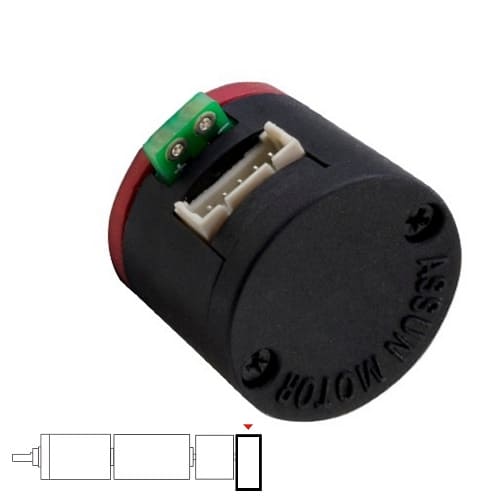 Some of the AssunMotor’s incremental encoders specifications that can be used in a variety of applications are as follows:
- Diameter: φ 16 to 36 mm
- Length: 11 mm to 12 mm
- Type: Incremental
- Principle: Electromagnetic or Optical Encoder
- Resolution: 32 ppr to 360 ppr (pulses per revolution)
- Max. Channels: 3
- Max. Working Frequency: 55 to 220 kHz
- Differential Signal: Yes or no
- Power Vcc: 5 V
- Signal Protocol: ISL32179 or TTL
- Operating Temperature: -40~125 ℃
- Inertia (Max.): 0.015 g.cm² to 1.18 g.cm²
- Max. Output Current/Channel: 1.5 to 20 mA
- Weight: 6.5 g to 29g
2 Types of Incremental Encoders
While all incremental encoders work to produce information about the direction and rotational angle, there are two main types, which include rotary and linear type encoders.
Rotary Type
A rotary encoder is the most commonly used type of encoder. Assun provides incremental rotary encoders that can provide information on position and direction. A rotary encoder operates by using a circular disc with a variety of open slots, and a fixed LED light or transducer. A rotary encoder has fixed slots on a spinning disc that provide output signals later interpreted based on pulses per revolution.
Linear Type
Linear encoders can provide information about the absolute position and positional angle, as well as direction. Linear incremental encoders work by measuring an output signal produced by a transducer that is placed on a scale. A motion controller is paired with the linear incremental encoder to translate the output signal, either in analog or digital form.
These types of linear encoders are usually reserved for uses in settings where there is linear movement, such as a conveyer belt or for counts, or machine stripping. For instance, you might find a linear encoder attached to a milling machine. The milling machine will use information gathered from the encoder to exert control over any of the materials passing through the milling machine.
Linear encoders might also be used in industrial printers. These linear encoders have a high resolution, usually about 1 mm. The more slots in the encoder, the higher the resolution. An infrared transmitter and receiver produce an output signal that can then be used to determine what direction a printer is moving.
It does so by measuring the output signals as two pulses. These pulses are offset by 90 degrees. If one pulse, known as the A pulse, trails in front of the other pulse, known as the b pulse, then the printer is moving forward, and vice versa. This is just one example of a configuration a linear encoder might use.
What are the Parts of the Incremental Encoder?
Incremental encoders use very simple parts that can easily be replaced, or the entire unit can be replaced for many applications.
An incremental optical encoder and magnetic encoder use similar parts, including a spindle assembly, a printed circuit board, or PCB, and a cover for the entire rotary encoders. The printed circuit board creates the two primary signals that will be used to measure position and speed. The position and speed measurement will produce output signals based on emitted light (such as in an optical incremental encoder) or using a magnetic sensor (such as in a magnetic incremental encoder).
Although different industries prefer using an optical encoder over a magnetic encoder and vice versa, both will produce output signals that can be used to determine the position, direction, and speed of an object.
Many optical encoders use light signals that won’t be affected by residual light, such as light used inside a factory or manufacturing center. These optical encoders can, therefore, have high levels of accuracy without fear of their information being affected by surrounding light.
Magnetic encoders are also simple to use since they gather information based on a magnetic sensor instead of light. Ultimately, different industries will choose these encoders based on preference.
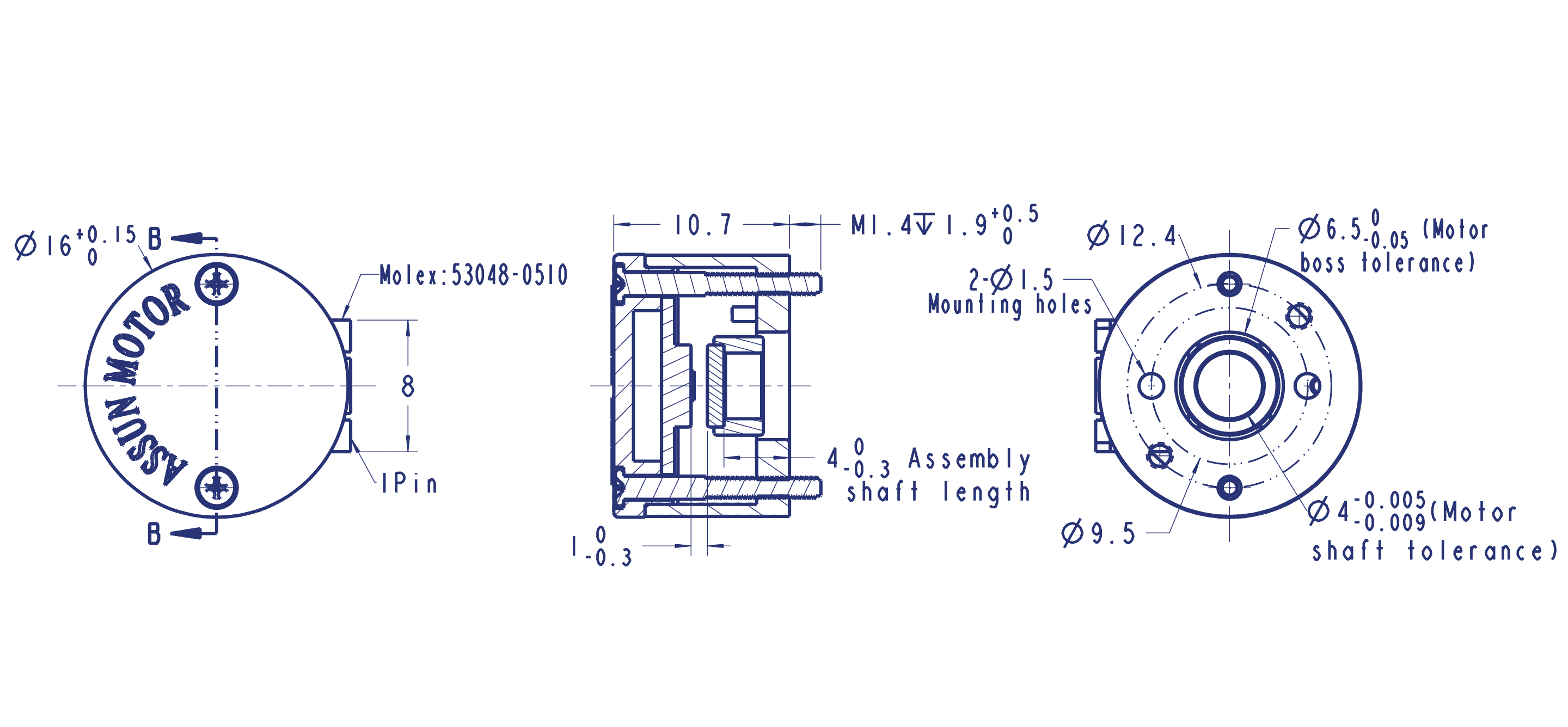
Assunmotor’s Incremental Encoder (Electromagnetic Type) – Cross Section
Where are Incremental Encoders Used?
Incremental encoders can be used in a variety of different applications. This includes:
- Can be used in an assembly line where a different number of counts are needed
- In robotics assembly lines
- In conjunction with brushless DC motors to create a hall sensor effect
- In milling machines, where it can determine the speed or direction of a specific material
- In industrial or home printers, to determine the direction of the printing process
- In health care industries such as in the equipment for a dialysis pump
- In food and beverage automated plants
- For use in the manufacturing of PCBs
- In computer numerical control (CNC) applications
The Bottom Line
There are many different types of encoders, including optical encoders, electromagnetic encoders, absolute, and incremental encoders just to name a few. Assun Motor has a wide selection of incremental encoders that can be used in servo settings and in DC motors, so you can get accurate real-time information on the position and direction of your assembly line.
Assun’s incremental encoders are essential tools in industries that require highly precise location information.
We have a variety of blogs available to help educate you on the differences between our incremental encoders, absolute encoders, and our high-quality encoders. Read through our blogs to find out more information about how incremental encoders can help improve your businesses’ production and output. Then look through our products and shop our line of encoders to find the highest quality products for your industry today.
You Might be Interested in Reading These;
Latest Posts
 by AssunMotor
Servo Motor Controller: How It Works, Applications & Benefits
In the realm of industrial automation and precision engineering, the ability to control motor movements with high accuracy is crucial. A servo motor...
 by Mir A. Hossain
What is a DC Motor and Its Working Principle?
A Direct Current motor, a DC motor, is an electrical instrument that is operated by direct current and transforms electrical energy into mechanical energy....
by AssunMotorUnderstanding DC Brushless Motor Efficiency & How to Test For It
Brushless DC motors are some of the most efficient and long-lasting motors available on the market today. But what exactly makes them so efficient compared...