logologologo
  • HOME
  • ABOUT US
  • PRODUCTS
    • Brushless Coreless Motor & Driver
    • Brushed Coreless Motor
    • Servo Motor
    • Servo Controller
    • Planetary Gearbox
    • Encoder
    • Brake
    • Harmonic Wave Gearbox
    • Documents Download
  • EVENTS
  • CONTACT US
  • BLOG
ONLINE SHOP
logologologo
  • HOME
  • ABOUT US
  • PRODUCTS
    • Brushless Coreless Motor & Driver
    • Brushed Coreless Motor
    • Servo Motor
    • Servo Controller
    • Planetary Gearbox
    • Encoder
    • Brake
    • Harmonic Wave Gearbox
    • Documents Download
  • EVENTS
  • CONTACT US
  • BLOG
ONLINE SHOP
logologologo
  • HOME
  • ABOUT US
  • PRODUCTS
    • Brushless Coreless Motor & Driver
    • Brushed Coreless Motor
    • Servo Motor
    • Servo Controller
    • Planetary Gearbox
    • Encoder
    • Brake
    • Harmonic Wave Gearbox
    • Documents Download
  • EVENTS
  • CONTACT US
  • BLOG
ONLINE SHOP
logologologo
  • HOME
  • ABOUT US
  • PRODUCTS
    • Brushless Coreless Motor & Driver
    • Brushed Coreless Motor
    • Servo Motor
    • Servo Controller
    • Planetary Gearbox
    • Encoder
    • Brake
    • Harmonic Wave Gearbox
    • Documents Download
  • EVENTS
  • CONTACT US
  • BLOG
ONLINE SHOP
logologologo
  • HOME
  • ABOUT US
  • PRODUCTS
    • Brushless Coreless Motor & Driver
    • Brushed Coreless Motor
    • Servo Motor
    • Servo Controller
    • Planetary Gearbox
    • Encoder
    • Brake
    • Harmonic Wave Gearbox
    • Documents Download
  • EVENTS
  • CONTACT US
  • BLOG
ONLINE SHOP
logologologo
  • HOME
  • ABOUT US
  • PRODUCTS
    • Brushless Coreless Motor & Driver
    • Brushed Coreless Motor
    • Servo Motor
    • Servo Controller
    • Planetary Gearbox
    • Encoder
    • Brake
    • Harmonic Wave Gearbox
    • Documents Download
  • EVENTS
  • CONTACT US
  • BLOG
ONLINE SHOP
  • HOME
  • ABOUT US
  • PRODUCTS
    • Brushless Coreless Motor & Driver
    • Brushed Coreless Motor
    • Servo Motor
    • Servo Controller
    • Planetary Gearbox
    • Encoder
    • Brake
    • Harmonic Wave Gearbox
    • Documents Download
  • EVENTS
  • CONTACT US
  • BLOG
by Mir A. Hossain
KnowledgebaseJanuary 20, 20240 comments 0 Likes

Servo Motor Vs Stepper Motor: How to Choose For Your Project?

Servo Motor: A servo motor is known as an electric motor that is used for exact control of angular or linear position, speed, and torque. It is an appropriate motor connected to a sensor for position feedback and a controller that adjusts the motor’s shifting.

Applications: Servo motor has huge industrial applications such as robotics, CNC machinery, and automated manufacturing for its high precision, fast response, and uniform.

Stepper Motor: A stepper motor is a brushless, synchronous electric motor that can transform digital pulses into mechanical shaft rotation. It is known as a digital input-output instrument. It is perfect for the application if control signals are displayed as digital pulses.

Applications: Stepper motors have different applications robotics, machine tools, pick and place machines, automated wire cutting and wire bonding machines etc.
Check out Assun Motor's Range of Planetary Gearboxes.

Table of Contents

Toggle
  • Comparison between Servo and Stepper Motor:
  • Differences between Servo and Stepper Motor (Table)
  • Conclusion

Comparison between Servo and Stepper Motor:

Servo and stepper motors are both useful control elements in industrial applications.  There are some key comparisons between servo and stepper motor. It is very important to understand the comparisons between those two motors to understand which motor is useful for applications. The following is a brief description of their comparisons.

  1. Motor Design:
  • Servo Motor:

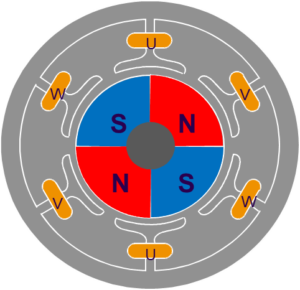
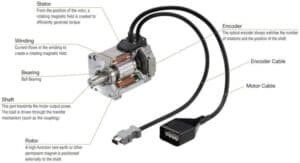
► Servo motor contains a rotor with 2-8 poles and a 3-phase stator.

►It is magnetized with permanent magnets instead of magnetized axially like a stepper motor.

►Less number of poles gives the capacity to produce higher torque at higher speeds.

servo motor structure image
  • Stepper Motor:

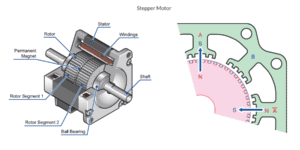
► Permanent magnet is sandwiched between two teeth and used in a stepper motor design.

► Rotor cup may include 50 or 100 teeth, and the two rotor cups are skewed at half a tooth pitch.  Every tooth on both rotor cups becomes a pole in a stepper motor.

► Stepper motor is able to run in open-loop without an encoder.

servo motor rotor and stator cross sectional diagram image
  1. Stop Accuracy: One of the important requirements for positioning applications for both stepper motor and servo motor is stop accuracy.
  • Servo Motor:

► Stop accuracy of the servo meter relies on the assembly accuracy, encoder resolution, and algorithm.

► Servo motors are “electrically designed” for positioning applications.

  • Stepper Motor:

► Stop accuracy of a stepper motor is largely based on the characteristics of its windings, accuracy of rotor construction, and the number of teeth/poles in its rotor.

► The stepper motor is designed mechanically for positioning applications.

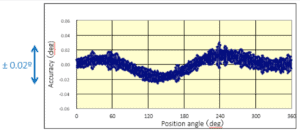
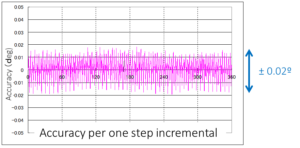
Both servo and stepper motors provide stop accuracy of around +/-0.02°.  A stepper motor provides better repeatability at 7.2° increments or almost perfect repeatability at 360° increments. On the other hand, the servo motor’s stop accuracy is dependent on its encoder resolution. The errors are shown in the following figure.

stop accuracy of servo motor graph
stop accuracy of stepper motor image
  1. High Speed Performance:
  • Servo Meter:

► Servo motors have higher speed than stepper motors.

► Servo motor is able to output more torque at a specified RPM than a stepper motor.

► Number of poles affects the number of times a motor winding needs to be advanced for a full motor revolution.

torque speed relationship of a servo motor graph
  • Stepper Motor:

► Different performance of torque happens due to the difference of pole count as well as winding inductance between the designs of servo motor and stepper motor.

► It is able to respond quickly, position accurately without an encoder, and easily generate holding torque.

► However, due to high winding inductance, pole count, and L/R constants, the torque decreases in the high speed region.

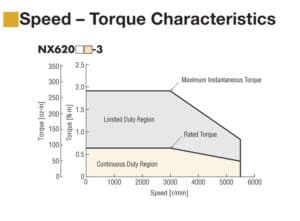
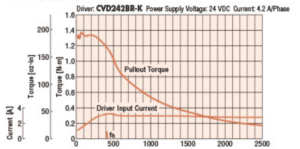
Difference of performance between stepper motor and servo motor can be shown through the following speed-torque curves:

torque speed relationship of a stepper motor graph
  1. Closed-Loop Feedback:
  • Servo motor:

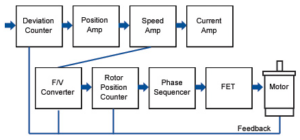
►Servo motor uses feedback method to control position, speed, or torque of the motor.

►Addition of feedback complicates the design of the driver and increases number of components.

► It is more expensive and requires more processing time. The ratio between load and rotor inertia of motor increases due to its closed-loop feedback.

closed loop feedback for servo motor
  • Stepper Motor:

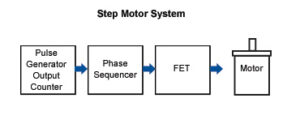
►Stepper motor is operated through a command to move to a specific location without feedback but may lose synchronism because of overload.

► Stepper motor can handle about 10 times of its rotor inertia and a servo motor can handle 100 times of its rotor inertia.

► It needs few components for operation because It can be operated without feedback.

► It is more cost-effective than servo motor.

no feedback loop for stepper motor
  1. Efficiency:
  • Servo meter:

► Closed-loop feedback of servo motor allows more efficient current control that affects motor temperature and service life.

► Efficient current control provides low noise and vibration.

  • Stepper Motor:

► Stepper motor uses a current chopper driver technology that provides a constant current supply regardless of load.

► It is better to produce holding torque at zero speed.

► It likes to vibrate more if it is not sized properly.

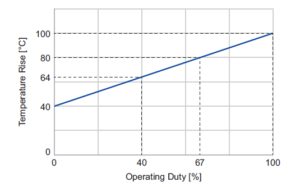
► The temperature rises with operating duty.  This is why duty cycle needs to be limited for stepper motors.

Plot of the temperature rise against the operating duty cycle [%] of a motor has been shown in the following figure:

temperature vs operating duty cycle chart

Differences between Servo and Stepper Motor (Table)

ParametersServo MotorStepper Motor
Operation SystemClosed LoopOpen Loop
SizeLonger BodySmall Body
Speed-Torque CharacteristicsHigh torque at high speedHigh torque at low speed
ResponsivenessDelay on startingQuick response
Synchronization,/strong>Motion delay with commandMotion synchronized with command
CostsHigherLower

Servo Motor:

Advantages:  ● Closed loop control● High torque at high speed ● Low motor heating ● Better for variable load system.

Disadvantages: ● Complex control – tuning required ● Position feedback required ● High system cost

Stepper Motor:

Advantages:  ● Simple design control ● No feedback required ● Excellent low speed torque ● Low system cost

Disadvantages:  ● Torque decreases as speed increases ● Constant current regardless of requirements ● Unable to react to changes of load.

Conclusion

Stepper motors are efficient for low-speed and accuracy applications. These are compact and inexpensive and good for medical, biotech, security and defense, and semiconductor manufacturing applications. On the other hand, servo motors are better for high speed and accuracy applications and good for packaging, converting, and web processing applications. The trade-off is a higher cost and complexity.

Check out Assun Motor's Range of Planetary Gearboxes.

Leave a Reply Cancel reply

Your email address will not be published. Required fields are marked *

Tags:
servo motor stepper motor
What is a Servo Motor and How Does it Work?Prev
Brushed Motor Design and Construction: Essential Principles and MethodsNext

Latest Posts

by AssunMotor

Servo Motor Controller: How It Works, Applications & Benefits

In the realm of industrial automation and precision engineering, the ability to control motor movements with high accuracy is crucial. A servo motor...

Servo Motor Controller: How It Works, Applications & Benefits

KnowledgebaseMarch 27, 2025
by Mir A. Hossain

What is a DC Motor and Its Working Principle?

A Direct Current motor, a DC motor, is an electrical instrument that is operated by direct current and transforms electrical energy into mechanical energy....

What is a DC Motor and Its Working Principle?

KnowledgebaseFebruary 20, 2024
by AssunMotor

Understanding DC Brushless Motor Efficiency & How to Test For It

Brushless DC motors are some of the most efficient and long-lasting motors available on the market today. But what exactly makes them so efficient compared...

Understanding DC Brushless Motor Efficiency & How to Test For It

KnowledgebaseFebruary 20, 2024
logo

ASSUN provides total solutions of precision DC drive to applications in different industries. Our innovative products consist of DC Brush & Brushless Motors, Planetary Gearbox, Servo Controller, Encoder and Brake.

LINKS

  • Home
  • About Us
  • Products
  • Events
  • Sitemap

OUR PRODUCTS

  • Brushless Coreless Motor
  • Servo Motor
  • Brake
  • Planetary Gearbox
  • DC Motor Controller
  • Brushed Coreless Motor
  • Encoder

CONTACT DETAILS

  • Contact Us
  • Shipping & Delivery Policy
  • Terms & Conditions
  • Privacy Policy


Copyright © 2024 Assun Motors Pte Ltd. All rights reserved.

CONNECT WITH US: