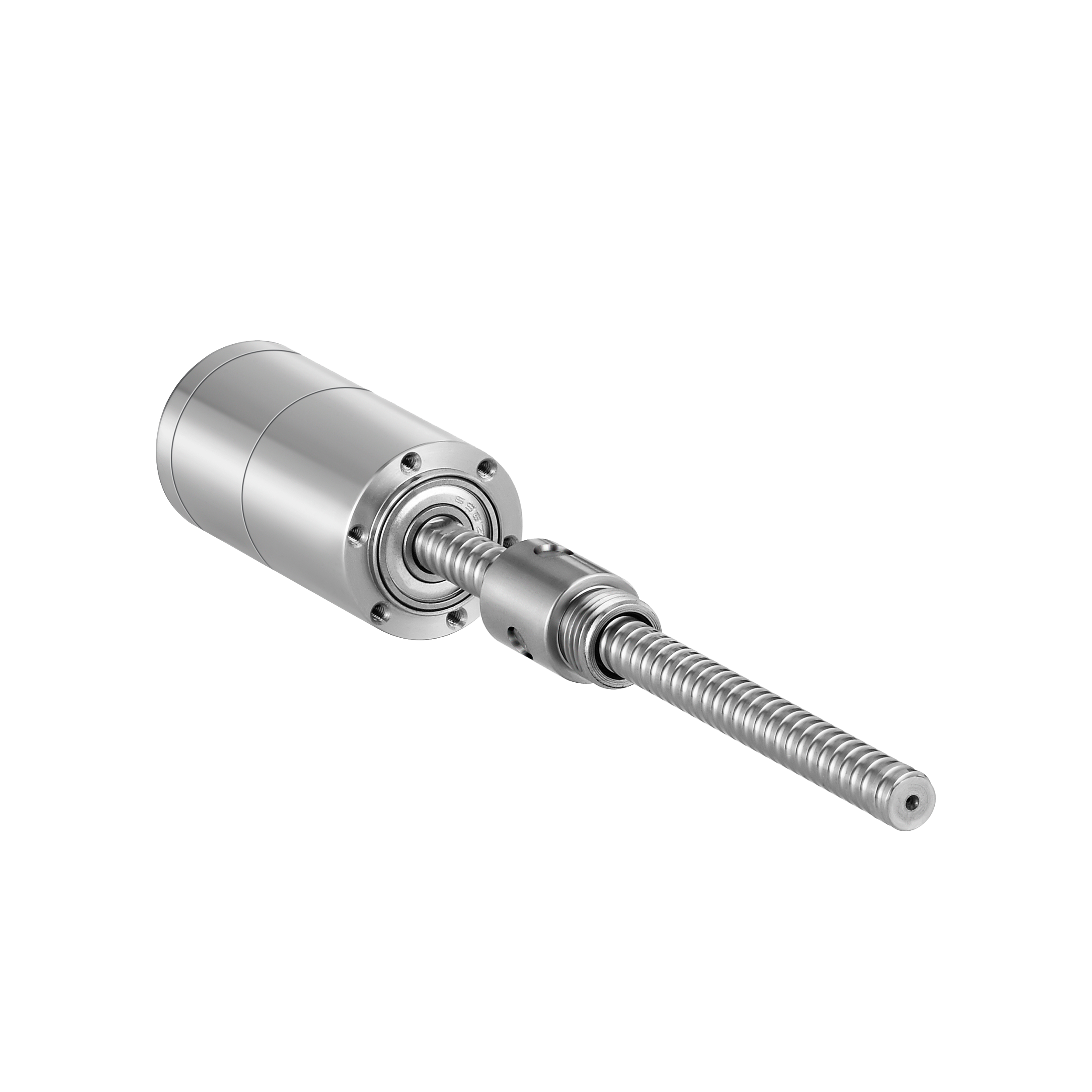
Precision GP Planetary Gearbox
All Assun geared linear actuators use a Precision (GP) planetary gearbox integrated between the DC motor and the screw mechanism. The GP gearbox is designed with tighter manufacturing tolerances to reduce backlash and improve transmission accuracy, delivering smooth and reliable linear motion.
Its precision design makes it well suited for applications that require repeatable positioning, including laboratory instruments, medical devices, optical equipment, and industrial automation.
Combined with either a ball screw or trapezoidal lead screw, the GP planetary gearbox helps provide accurate positioning, efficient power transmission, and dependable performance across Assun's geared linear actuator range.
Geared Linear Actuator vs Servo Actuator
Assun makes two products that both integrate a DC motor and a gearbox a geared linear actuator and a servo actuator. The key difference is in the motion output:A geared linear actuator produces linear (straight-line) displacement the output is a screw shaft that moves forward and backward along an axis. The load moves in a straight line.
A servo actuator produces rotary output the output is a shaft that rotates to a commanded angular position. The load moves around an axis.
Choose a geared linear actuator when your application requires push or pull force along a fixed axis: medical bed adjustment, optical stage positioning, gripper actuation, valve operation.
Choose a servo actuator when your application requires rotary joint motion: robot arm joints, gimbal drives, antenna positioning. Both products are available for direct online purchase through the Assun online shop.
Where Assun Geared Linear Actuators Are Specified?
Assun's geared linear actuators are specified across several precision motion application areas in the US:Laboratory and Diagnostic Instruments: GP (Precision) series ball screw actuators with small screw diameters (3mm–6mm) are used in pipetting robots, microplate handlers, and optical positioning stages where positioning repeatability is required at sub-millimetre resolution. The ball screw's high efficiency reduces heat build-up in benchtop instruments where thermal management is constrained.
- Medical Equipment and Patient Positioning: Trapezoidal lead screw (AM-TS) actuators are well-suited to hospital bed adjustment, surgical table positioning, and patient lift mechanisms. The self-locking property means the position holds when power is removed essential for patient safety. The longer TS series stroke lengths (up to 301mm) support the extended travel requirements of positioning systems.
- Factory Automation and Robotics: Ball screw actuators handle repetitive high-cycle linear motion in pick-and-place robots, dispensing systems, and precision assembly tooling where speed and accuracy must both be maintained over millions of cycles.
- Optical and Photographic Systems: Miniature ball screw actuators (3mm–6mm diameter, GP gearbox) provide the controlled, repeatable linear motion needed for focus adjustment, filter positioning, and lens stage drives in scientific and industrial optical instruments.
FAQs
Q1. What is a geared linear actuator?
A geared linear actuator is a motion device that converts DC motor rotation into precise straight-line movement using a gearhead and a screw mechanism. The gearhead (typically a planetary gearbox) multiplies the motor's output force while reducing speed, and the screw converts the resulting rotary output into linear displacement. Geared linear actuators are used in applications requiring controlled push or pull force over a defined stroke length from laboratory instruments and medical equipment to factory automation and optical systems.
Q2. What is the difference between a ball screw and a lead screw actuator?
A ball screw uses recirculating ball bearings between the screw shaft and nut, giving it high efficiency (85–95%) and precise, low-friction motion ideal for high-cycle precision applications. A lead screw (including trapezoidal thread variants) uses direct thread contact, which produces more friction and lower efficiency but creates a self-locking condition: the actuator holds its position under load when the motor is off without requiring a brake. Choose ball screw for horizontal precision motion and high duty cycles. Choose lead screw for vertical lift applications where position-holding under power loss is a safety requirement.
Q3. What does 'self-locking' mean in a linear actuator?
A self-locking linear actuator will not back-drive when an axial load is applied to the output shaft while the motor is de-energised. In a trapezoidal lead screw actuator, the thread geometry creates enough friction to resist the back-driving force of a typical load. This is important in vertical applications a hospital bed adjustment mechanism, for example, must hold its position if power is lost. Ball screw actuators are not self-locking and require a brake or holding current for vertical load-holding.
Q4. What is the screw diameter range for Assun's geared linear actuators?
Assun's ball screw (BS) series covers screw diameters from 3mm to 12mm, with stroke lengths from 56mm to 201mm. The trapezoidal lead screw (TS) series covers 4mm to 20mm screw diameter with stroke lengths up to 301mm. In total, 19 standard SKU configurations are available for direct purchase through the Assun online shop. Custom screw diameters, leads, and lengths can be requested through Assun's US engineering team.
Q5. How does a geared linear actuator differ from a servo actuator?
A geared linear actuator produces linear (straight-line) displacement its output shaft moves forward and backward along an axis. A servo actuator produces rotary output its output shaft rotates to a commanded angular position. Use a geared linear actuator when the load must move along a fixed axis (push/pull motion). Use a servo actuator when the load must rotate around a joint axis. Both products are available from Assun geared linear actuators at /products/geared-linear-actuator, servo actuators at /products/servo-actuator.
Q6. What motors are used to drive Assun's geared linear actuators?
Assun's geared linear actuators are driven by DC motors from Assun's motor range. The gearhead between motor and screw can be configured to work with both brushed coreless DC motors and brushless coreless DC motors (BLDC), depending on the model. The motor type determines the actuator's continuous current requirement, speed range, and whether a matching BLDC driver is needed. Contact Assun's US engineering team for model-specific motor compatibility confirmation.
Q7. Can Assun's geared linear actuators be used in cleanroom environments?
This depends on the specific model and installation requirements. The trapezoidal lead screw series uses a plain thread interface that generates more particulate than a ball screw under comparable loads ball screw actuators are generally preferred in cleanroom environments where particle generation must be minimised. For cleanroom compatibility requirements (ISO class, particulate limits), please contact our US engineering team to confirm suitability for your specific installation conditions.

 Online Shop